How Wind Pressure Reports Are Created Today
- Home
- How Wind Pressure Reports Are Created Today


James Miller
June 5, 2026
For most homeowners, a wind pressure report is an invisible part of a window or door replacement project.
They never see the calculations, the engineering review, or the permitting documentation. What they do notice are project delays, permit hold-ups, and installation dates that seem to move further into the future.
Behind the scenes, however, wind pressure reports have become one of the most critical pieces of documentation required throughout Florida's construction industry.
The process of creating these reports has remained largely unchanged for years. While building technology has evolved rapidly, many contractors still rely on workflows that involve multiple parties, manual calculations, and engineering reviews that can add significant time and cost to a project.
Understanding how wind pressure reports are created today helps explain why permitting often becomes one of the biggest challenges facing window and door contractors.
In most cases, a contractor begins by collecting measurements from the property.
Window sizes, door dimensions, building height, roof type, and project location must all be documented before any engineering calculations can begin.
Once this information is assembled, it is typically sent to an engineering company that specializes in wind load analysis.
The engineering team then reviews the project and performs calculations based on Florida Building Code requirements, ASCE 7 standards, local wind speeds, exposure conditions, and other structural variables.
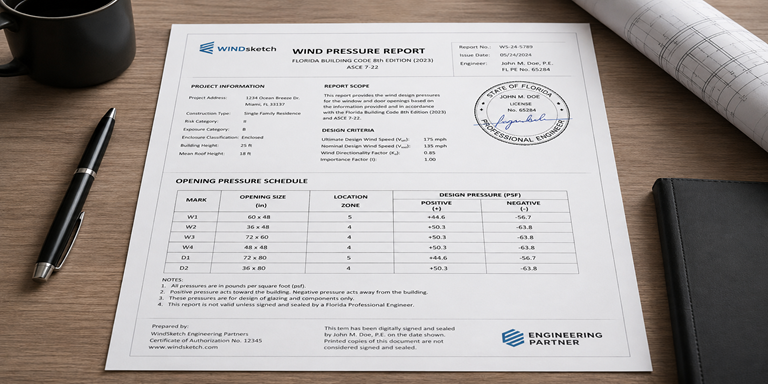
After the calculations are completed, the engineering company generates a wind pressure report that can be submitted as part of the permit package.
While this process is well established, it often introduces delays because contractors must wait for an outside party to complete the engineering work.
Depending on project volume and engineering availability, turnaround times can range from several days to well over a week.
Many people assume wind pressure calculations involve simply looking up a wind speed and applying it to the building.
The reality is far more complex.
Every structure has unique characteristics that influence the final design pressures.
Engineers must evaluate factors such as:
Some of the most challenging variables involve determining the specific wind pressure zones that apply to each opening.
Areas commonly referred to as Zone 4 and Zone 5 can experience significantly higher wind loads than other portions of the structure. Openings located within these regions often require different calculations and, in some cases, stronger products.
Accurately identifying these zones requires experience, engineering knowledge, and a detailed understanding of building code requirements.
Even small mistakes can result in incorrect calculations, permit revisions, or rejected submissions.
Beyond the calculations themselves, contractors often face another challenge: managing the process internally.
Many companies rely on a dedicated estimator, permit coordinator, project manager, or office administrator who understands how engineering requests must be prepared and submitted.
The success of the process frequently depends on having someone who knows exactly what information engineering firms require.
If measurements are incomplete, opening schedules are inaccurate, or project information is missing, additional revisions may be necessary.
Each revision introduces more delays.
For growing companies processing dozens of projects every month, the administrative burden can become substantial.
The engineering fee is only part of the cost. The time spent collecting information, organizing documentation, communicating with engineers, and tracking revisions often represents an even larger operational expense.
As permitting requirements have become more sophisticated, many jurisdictions have increasingly preferred opening-specific wind pressure reports.
Rather than applying generalized assumptions across an entire structure, opening-specific calculations evaluate each window and door individually.
This approach provides greater accuracy and often improves confidence during permit review.
However, traditional opening-specific reports have historically been associated with higher engineering costs and longer turnaround times.
The increased level of detail requires additional analysis, which can make the process more expensive for contractors and homeowners alike.
As a result, many companies have found themselves choosing between speed, cost, and precision.
The window and door industry has embraced digital estimating, cloud-based project management, mobile field applications, and automated measurement tools.
Yet wind pressure reporting has often remained disconnected from the rest of the workflow.
Project information is entered into one system.
Measurements are stored in another.
Engineering requests are submitted through emails.
Calculations are completed elsewhere.
The result is a fragmented process that creates opportunities for delays, duplication, and human error.
For an industry that increasingly depends on efficiency, this approach is becoming difficult to justify.
At WindSketch, we saw an opportunity to modernize one of the most important steps in the permitting workflow.
Instead of treating wind pressure calculations as a separate engineering process, we built a system designed to integrate directly into the way contractors already create and manage projects.
The platform automatically organizes much of the information required for engineering review, reducing the amount of manual preparation traditionally required before calculations can begin.
Critical factors such as opening locations, dimensions, wind pressure zones, and project-specific details can be incorporated directly into the workflow.
This significantly reduces the administrative effort required from contractors while helping improve consistency and accuracy.
Perhaps the biggest improvement is speed.
Through partnerships with engineering companies in Florida, WindSketch has streamlined the path from project creation to certified report delivery.
Instead of waiting a week or longer for engineering calculations, contractors can receive fully certified opening-specific wind pressure reports in as little as 24 hours.
These reports are prepared and certified by licensed engineering partners while leveraging the efficiency of an integrated workflow designed specifically for window and door replacement projects.
The result is a process that combines engineering accuracy with modern operational efficiency.
As Florida continues to strengthen building standards and permitting requirements become increasingly detailed, the demand for accurate engineering documentation will only grow.
Contractors who continue relying on fragmented workflows may find themselves facing longer timelines, higher administrative costs, and greater permitting challenges.
The industry is moving toward a future where engineering calculations, project design, permitting preparation, and project management work together as a single connected process.
Wind pressure reports will remain essential.
The difference is that obtaining them no longer has to be slow, expensive, or difficult.
For contractors seeking a faster path to permit approval, the future of wind pressure reporting may already be here.

James Miller works as a Customer Support Specialist at Windsketch, a software company for the window and door industry. With a knack for problem-solving and a deep understanding of Windsketch's products, James efficiently resolves client issues, ensuring they get the most out of their software. His technical skills and customer-focused approach have made him a valuable asset to both Windsketch and its customers.